Lead-to-Cash Optimization: Seven Places Your B2B Funnel Is Leaking Revenue

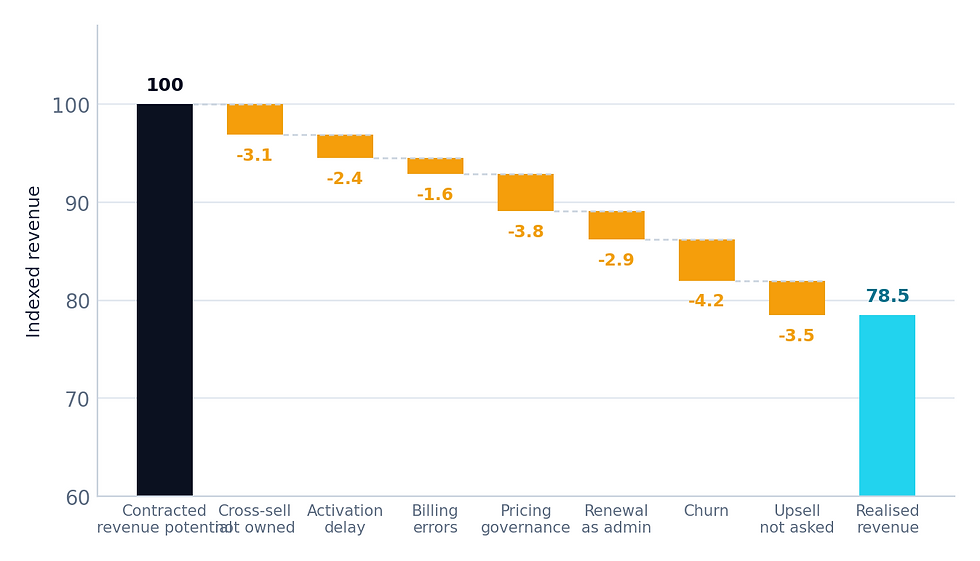
Revenue leakage is expensive out of proportion to its visibility because none of the seven failures below trigger an alert — each one records as a success. The instinctive priority order puts churn first; the economics argue for activation and expansion first, because retention has a hard ceiling and expansion does not. Underneath all seven is a single conceptual failure: treating each revenue event as complete in itself rather than as a position in a longer sequence.
Revenue leakage is difficult to fix for a structural reason: it does not appear on any report. A lost deal shows up. A churned customer shows up. A renewal that quietly repriced downward because nobody prepared for the conversation does not show up anywhere, because the renewal happened and the number was booked and the system recorded a success.
This is what makes leakage expensive out of proportion to its visibility. Every one of the seven failures below is happening in most companies at this scale right now, none of them will trigger an alert, and in aggregate they typically account for more foregone revenue than the entire new business shortfall that occupies the leadership team's attention.
The framing worth holding throughout: acquiring a new customer is conventionally estimated to cost somewhere between five and twenty-five times what retaining an existing one costs. The range is wide because it varies enormously by model, and it is a widely repeated rule of thumb rather than the finding of a single study — but even the bottom of the range makes the point. Every dollar leaking from the installed base is a dollar you have to reacquire at several times the cost.
EXHIBIT 1
Seven leaks, none of which appear on a report
One: the cross-sell that nobody owns
The most common leak in a multi-product company is that expansion is everyone's opportunity and nobody's job.
The mechanism is a gap in the operating model. Account executives are compensated on new logos and typically move on after the first close. Customer success is compensated on retention and health, and raising a commercial conversation feels like a risk to the relationship they are measured on. So the second product is mentioned occasionally, opportunistically, by whoever happens to be on the call, and the attach rate ends up a fraction of what the product fit would support.
The fix is not exhortation. It is instrumentation and ownership. The system should identify expansion-eligible accounts from usage and firmographic signals rather than relying on someone remembering. The resulting opportunity should be assigned to a named owner with a defined motion. And the compensation structure needs to make the conversation rational for the person having it — if the person best positioned to identify expansion has no economic interest in it, they will keep not identifying it, forever, regardless of how many times it is raised in a quarterly meeting.
Two: the activation delay
A signed contract is not revenue. It is a promise of revenue conditional on the customer actually reaching the point where the product is doing something for them. The gap between those two moments is where a surprising amount of value dissolves.
The damage is compounding rather than linear. A customer whose time-to-value is measured in weeks arrives at their first renewal with an accumulated experience of the product working. A customer whose activation stalled for a month arrives with an accumulated experience of chasing your implementation team, and that experience prices itself into every subsequent negotiation. It also shows up in expansion: accounts that activate slowly expand at meaningfully lower rates, because expansion requires the confidence that the first purchase worked.
The operational cause is almost always a handoff. The information gathered during the sales process — what they are trying to achieve, what their constraints are, who the actual users will be — is not transferred in structured form, so onboarding starts by re-discovering it. Instrumenting that single handoff, with a defined payload and a service level, is one of the highest-return pieces of work available in lead-to-cash optimisation and one of the least frequently done, because it sits between two teams and belongs to neither.
Three: billing errors
Billing errors are unusual among revenue leaks in that they are simultaneously trivial to describe and disproportionately damaging.
The direct cost is under-billing: the discount applied that should have expired, the seat count that never updated after expansion, the usage tier that was never enforced, the annual increase written into the contract and never applied. Each instance is small. Multiplied across a customer base over several years, the aggregate is frequently a visible percentage of revenue.
The indirect cost is larger and lands on the customer relationship at the worst possible moment. A wrong invoice arriving in the first ninety days undoes a substantial portion of the trust the sales process built, because it is the first operational interaction the customer has with you after committing money. It signals — accurately — that your systems do not talk to each other.
The root cause is transcription. Contract terms are agreed in one system, re-keyed into another, and provisioned in a third. The fix is to make the closed-won event the trigger for a structured data flow rather than the start of a manual sequence, and to hold contract terms as structured data rather than as prose in a document that a human has to interpret.
Four: pricing governance
Pricing leakage is the one most companies find most uncomfortable to examine, because the analysis tends to be unflattering to people rather than to systems.
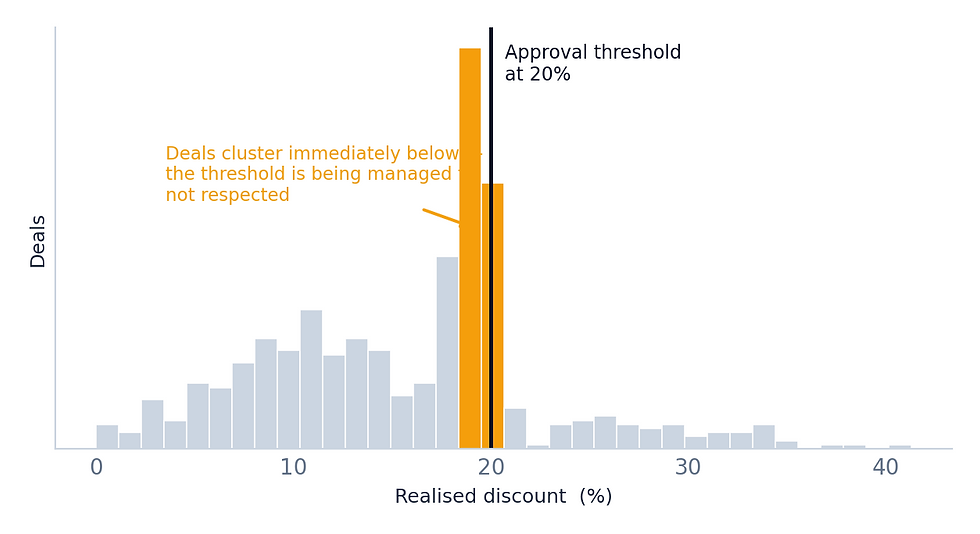
The pattern: a discount approval framework exists on paper. In practice, exceptions are granted through direct escalation at quarter-end, when the pressure to close is highest and the scrutiny is lowest. The exceptions are individually justified — this is a strategic logo, this is a competitive situation, this opens a new vertical. Over eight quarters, the exceptions become the pattern, the list price becomes an opening position that nobody expects to hold, and the discount floor drifts down permanently because sales teams learn what is actually achievable and price to it.
The diagnostic is a straightforward distribution analysis: plot realised discount by deal, by rep, by quarter, by segment. The distribution reveals whether you have a pricing policy or a pricing suggestion. The characteristic finding is a sharp cluster just below whatever threshold triggers additional approval, which tells you the threshold is being managed to rather than respected.
EXHIBIT 2
The evidence is in the distribution, not the policy
The fix is governance with teeth: approval that is genuinely required rather than nominally required, discount authority tied to something defensible such as term length or payment structure rather than to negotiating pressure, and quarterly visibility of realised pricing at the leadership level. The uncomfortable part is that this requires the founder to hold the line at quarter-end, which is exactly when holding it is most costly.
Five: renewals treated as administration
Most renewal processes are calendar-driven. Sixty or ninety days out, someone is notified, an email is sent, and a conversation happens. This treats renewal as a transaction to be processed rather than a decision the customer has been making continuously for twelve months.
By the time a renewal appears on a calendar, the outcome is largely determined. The customer has already formed a view based on whether the product delivered, whether support was responsive, whether the people who championed the purchase are still employed, and whether anyone from your company demonstrated interest in their outcomes between the purchase and the renewal notice. A well-executed sixty-day process cannot reverse eleven months of neutral experience.
The structural fix is to make renewal a continuous state rather than an event. Health signals — usage trend, breadth of adoption across seats, support escalation pattern, engagement of the original champion, changes in the account's own business — should be monitored continuously with defined thresholds that trigger intervention when there is still time to intervene. A usage decline detected in month four is a solvable problem. The same decline detected in month eleven is a discount negotiation.
There is a second, subtler renewal leak: silent auto-renewals that repeat existing terms without any commercial conversation. These feel like wins because they close without effort. They are frequently losses, because the account grew, the usage increased, and the contract renewed at a price set against a smaller version of the customer.
Six: churn that was visible
Churn is the most-discussed leak and, in a sense, the least interesting, because by the time an account is churning the mechanism is usually well understood in hindsight and the analysis has been done many times before.
What is worth examining is the distinction between churn types, because they have different owners. Churn from a customer who never activated is an onboarding failure. Churn from a customer who activated and then declined is a product or account management failure. Churn from a customer who was never a fit is a qualification failure — and this is the category that most rewards attention, because it is the one that leadership least wants to hear.
Poorly qualified customers are expensive twice: once in acquisition cost that never recovers, and again in the disproportionate support and success resource they consume while they are present. A qualification bar that is genuinely enforced looks in the short term like a smaller pipeline. In the medium term it looks like better retention, better economics, and a customer success team with capacity for the accounts that can actually grow.
Seven: the upsell that was never asked for
The last leak is the one that shows up in the net retention number and nowhere else: accounts that would have bought more and were never asked.
The signals are almost always present in the product data. A team using every seat they purchased. Consumption running consistently near a tier ceiling. New departments appearing in the user list. Feature usage patterns that map to a higher tier. These are not subtle. They are simply not being watched by anyone whose job is to act on them.
This is the highest-return automation opportunity in most B2B SaaS companies, because the qualification is essentially already complete. The account has bought, activated, and demonstrated need. What is missing is a system that notices and a person whose job it is to respond.
Where the real strength is
The instinctive priority order among these seven puts churn first, because churn is visible and painful. The economics argue for a different order.
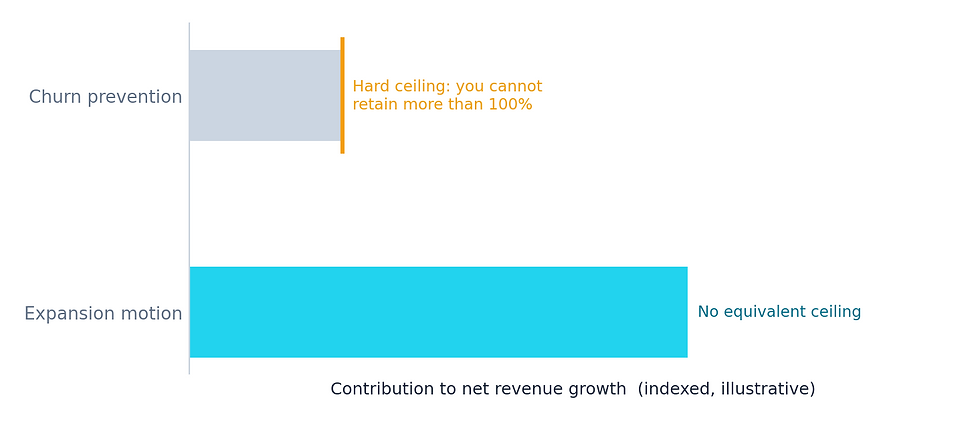
Retention has a ceiling. The best possible outcome from a churn programme is that you lose nothing, which caps its contribution at whatever you are currently losing. Expansion has no equivalent ceiling. In companies with mature expansion motions, expansion revenue commonly contributes substantially more to growth than churn prevention does — often by a factor that makes the prioritisation question straightforward. And critically, the operational work that produces expansion is largely the same work that produces retention. An account that is monitored for expansion signals is an account that is being monitored, which is the condition under which churn risk becomes visible early.
EXHIBIT 3
Retention has a ceiling; expansion does not — and the operational work that produces expansion delivers retention as a side effect
So the sequence that follows from the economics is: fix activation, because it determines everything downstream. Then instrument expansion, because it produces the largest return and delivers retention as a side effect. Then address pricing governance, because it is pure margin. Churn work comes after, targeted specifically at the qualification failures rather than treated as a general programme.
Single moves and multi-move thinking
Underneath all seven leaks is one conceptual failure, and it is worth naming because fixing it changes how the rest of the work is prioritised.
Single-move thinking treats each revenue event as complete in itself. The deal closes and the transaction concludes. Multi-move thinking treats each event as a position in a longer sequence: this deal at this price with this customer, structured this way, determines what is possible at renewal and expansion. Under single-move thinking, a deep discount to close a quarter is a win. Under multi-move thinking, it is a decision to permanently reprice an account and, because customers talk within their sectors, potentially a segment.
The practical consequence is that your systems must speak with one voice across the full lifecycle. A CRM that knows what was sold, a billing system that knows what was invoiced, a product that knows what is used, and a success platform that knows what is happening — connected, so that any one of them can answer a question that requires the others. That is not a reporting requirement. It is what makes multi-move decisions possible at all, because you cannot reason about a sequence you can only see one frame of.
Questions for your next leadership review
Of the seven leaks, which two are you not currently measuring at all? Those are the candidates, because an unmeasured leak has been running at full rate for as long as it has existed.
Plot realised discount against your approval threshold. Is there a cluster immediately below it?
Who is compensated on expansion? If the person best positioned to identify it has no economic interest in it, the attach rate you have is the attach rate you will keep.
How we approach it
Lead-to-cash process optimisation is one of the six services we run at RevOps Quantum. We map the full lifecycle, instrument the handoffs, connect the systems that currently require transcription, and quantify what each leak is costing before recommending which to close first.
The RevQ Model is how we locate them: three layers — Signal, Conversion, and Action — read across four revenue states of Acquire, Convert, Expand, and Scale. Most of the seven leaks above live in Expand, which is also where most companies have the least instrumentation and the most upside.
Our pricing is on our site. So is the diagnostic.


Comments