Full-Funnel Conversion for B2B SaaS: From First Touch to Closed-Won Without Leaking Pipeline

Your pipeline report says $2.4M in active opportunities. Your quarterly revenue target is $800K. At 3x coverage, the maths should work. It does not. You close $320K. Win rate: 13 percent. The pipeline was full. The revenue was not.
This is pipeline leakage — the silent destruction of revenue between the top of funnel and closed-won. It does not show up in any single metric. It shows up in the gap between what the pipeline promised and what the bank account received. And in B2B SaaS companies between $5M and $50M ARR, it is almost always the primary reason the company misses its number.
The problem is not that the funnel has a leak. It is that the funnel has multiple leaks at multiple stages, each compounding the next. A 5 percent drop in conversion at one stage cascades through every subsequent stage. Across six stages, even modest losses at each level can reduce the final output by 60 to 70 percent. Fixing the wrong leak — or optimising one stage without diagnosing which stage leaks the most — produces marginal improvement at best and misdirected spend at worst.
This article maps the full B2B SaaS funnel, identifies where pipeline most commonly leaks, and provides the conversion benchmarks and intervention framework that a fractional CMO uses to plug the leaks in priority order.
What is a full-funnel B2B marketing strategy?
A full-funnel strategy treats the buyer journey as a single, integrated system from first anonymous website visit to closed-won deal — not as a marketing function that generates leads at the top and a sales function that closes them at the bottom. The critical distinction: in a full-funnel approach, every stage is measured, every transition has an owner, and every conversion rate is benchmarked against a target that the entire revenue team has agreed on.
In most SaaS companies, the funnel is divided between teams with no shared accountability. Marketing owns awareness and lead generation. Sales owns qualification and closing. Nobody owns the transitions between stages — the handoffs where the majority of pipeline leaks.
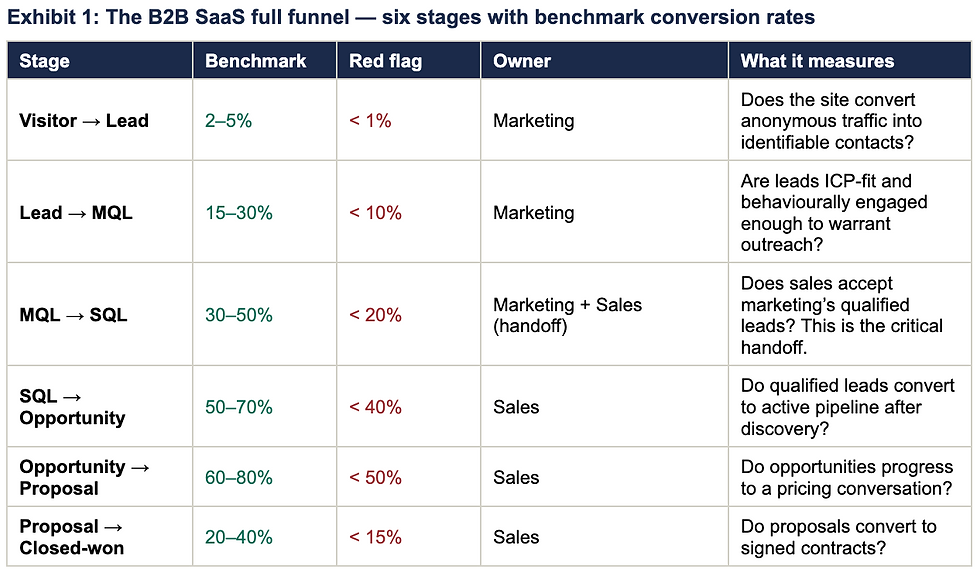
The compounding effect is what makes funnel analysis essential. Consider a company that generates 10,000 website visitors per month. At benchmark conversion rates across all six stages, the funnel produces approximately 15 to 30 closed-won deals per month. Drop each stage by just 5 percentage points below benchmark and the output falls to 3 to 7 deals — a 50 to 75 percent reduction in revenue from the same traffic volume.
This is why optimising a single stage without measuring all stages produces misleading results. A landing page test that improves visitor-to-lead conversion by 20 percent is meaningless if the MQL-to-SQL handoff leaks 60 percent of those leads. A full-funnel strategy measures every stage simultaneously so that effort goes to the stage with the largest absolute leakage — not the stage that is easiest to optimise.
Where does pipeline leak in B2B funnels?
After auditing funnels across 30-plus B2B SaaS companies between $5M and $50M ARR, the leakage pattern is remarkably consistent. Five points account for the vast majority of lost pipeline.
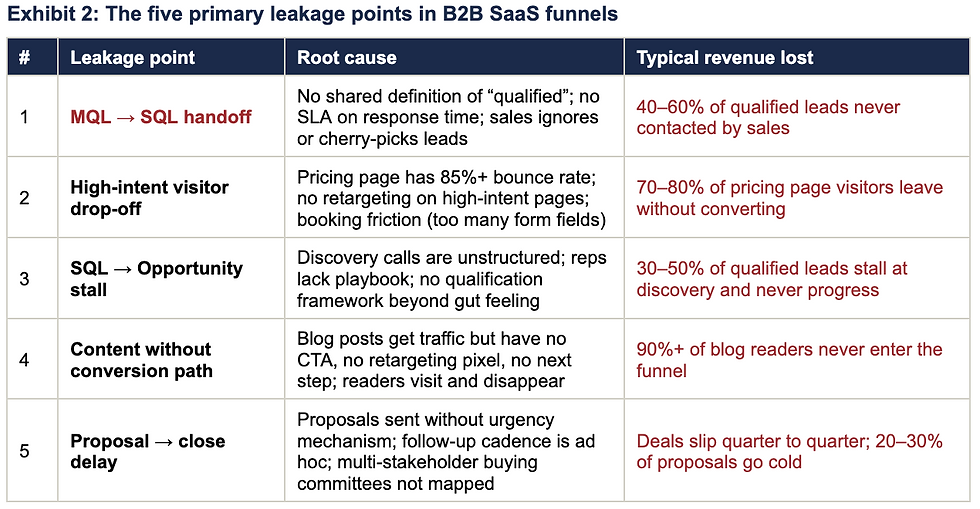
The MQL-to-SQL handoff is the single largest leakage point in most B2B SaaS funnels. It is the stage where pipeline crosses from marketing’s responsibility to sales’s — and in the absence of shared definitions and SLAs, the transition is where the most value is destroyed.
The typical pattern: marketing generates a lead that meets the scoring threshold and passes it to sales. Sales looks at the lead, decides it is not “ready” based on intuition rather than data, and deprioritises it. The lead waits 48 to 72 hours. By then, buyer intent has decayed.
The competitor who responded in 5 minutes has already had the discovery call. Research consistently shows that responding to a lead within 5 minutes produces a 10x higher contact rate than responding in 30 minutes. Most SaaS companies respond in 24 to 48 hours. The maths is brutal.
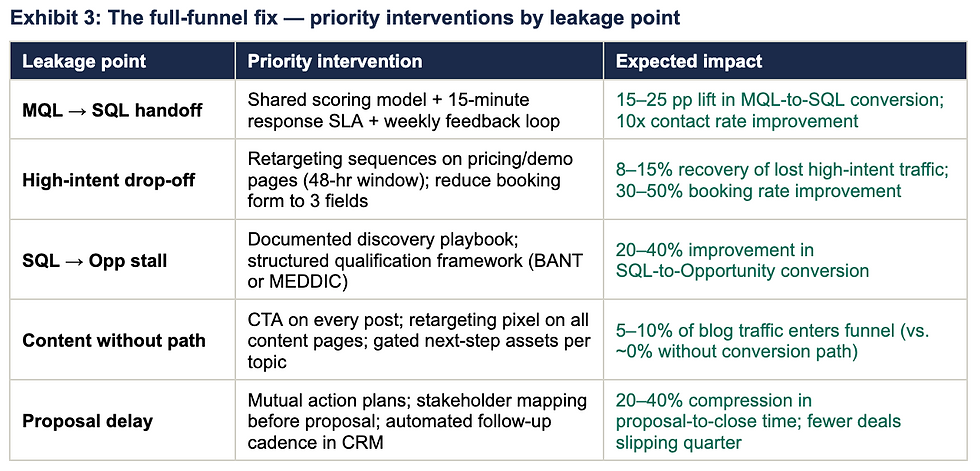
High-intent visitor drop-off is the second largest leak. Your pricing page — the highest-intent page on the site — has a bounce rate above 85 percent. Your booking page loses 90 percent of visitors to friction. These are buyers who came to your site with purchase intent and left without converting. Without retargeting sequences that re-engage these visitors within 48 hours, the intent evaporates. A structured retargeting sequence targeting pricing and demo page visitors typically recovers 8 to 15 percent of this lost traffic.
Content without conversion path is the most under-recognised leak. The blog gets 15,000 page views per month. It generates traffic and possibly SEO authority. But without a CTA on every post, a retargeting pixel, and a next-step offer relevant to the content topic, those 15,000 visits produce zero pipeline. Content that generates readers but not leads is a cost centre, not a demand engine. The fix is structural: every piece of content needs a conversion path — a CTA, a gated asset, or at minimum a retargeting tag that serves conversion-focused content within 7 days.
Proposal-to-close delay is the leak that kills quarters. Proposals are sent and then followed up sporadically. The buying committee has five stakeholders, and the AE has only engaged two. The proposal sits in someone’s inbox while the champion loses internal momentum. A structured close process — mutual action plan with the buyer, all stakeholders mapped and engaged before the proposal, follow-up cadence built into the CRM — compresses this stage by 20 to 40 percent.
How do you improve sales-marketing handoff in SaaS?
The sales-marketing handoff is where the largest volume of pipeline dies in B2B SaaS. Fixing it requires three structural interventions that go beyond “better communication” and into documented, measurable, enforceable systems.
Intervention 1: Shared lead scoring model with qualification threshold
Marketing and sales must agree — in writing, with sign-off from both leaders — on what constitutes a qualified lead. This means a lead scoring model in HubSpot or Salesforce that combines firmographic criteria (company size, vertical, tech stack matching the ICP) with behavioural criteria (pricing page visit, case study download, webinar attendance, demo request). A lead crosses the MQL threshold only when it meets both firmographic and behavioural minimums.
The scoring model eliminates the “good lead / bad lead” debate. If a lead meets the threshold, it is qualified by definition. If sales disagrees with the quality, the response is to adjust the threshold — not to ignore leads that meet it. Companies with precise ICP-based scoring achieve 2.5 times higher conversion rates through the funnel (Bain).
Intervention 2: Response time SLA with enforcement mechanism
The SLA specifies: when a lead crosses the MQL threshold, sales must make first contact within a defined time window. For most mid-market SaaS companies, the target is 15 minutes during business hours and 2 hours outside business hours. The SLA is tracked in the CRM with automated alerts. If the SLA is breached, the lead is escalated to a backup rep or a manager is notified.
This is not optional discipline. It is the single highest-ROI process change available. The difference between 5-minute and 30-minute response is a 10x drop in contact rate. The difference between 30-minute and 24-hour response effectively destroys the lead’s value entirely. Every SaaS company that implements response time SLA enforcement sees an immediate lift in MQL-to-SQL conversion — typically 15 to 25 percentage points.
Intervention 3: Structured feedback loop
A weekly 30-minute meeting where sales provides structured feedback on lead quality to marketing. Not anecdote (“the leads were bad this week”) but data: which leads were contacted, which progressed, which were rejected, and why. The rejection reasons are categorised (wrong company size, wrong vertical, wrong timing, already in conversation with competitor) and fed directly into the scoring model and campaign targeting.
This feedback loop is the mechanism that makes the handoff self-improving. Each month, the scoring model gets more accurate because it incorporates real sales feedback. Each quarter, the ICP definition sharpens because it reflects actual close patterns. Without this loop, the handoff degrades over time as market conditions shift and the scoring model grows stale.
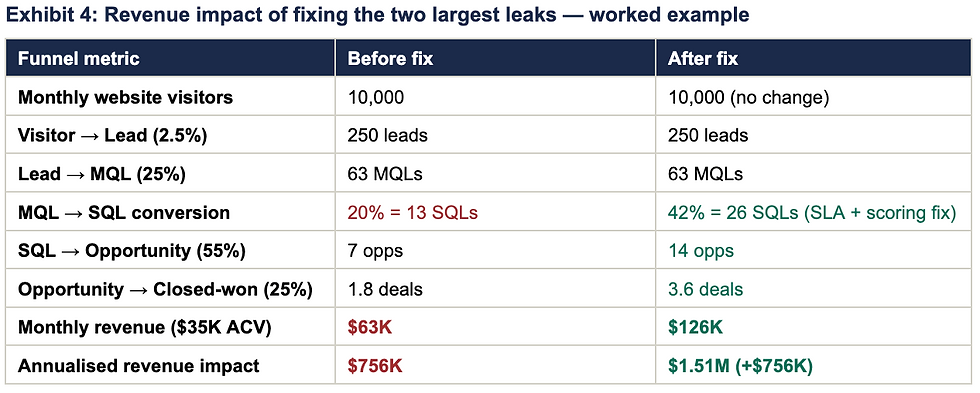
The worked example in Exhibit 4 demonstrates the compounding mathematics of funnel optimisation. By fixing only one stage — the MQL-to-SQL handoff, from 20 percent conversion to 42 percent through scoring and SLA implementation — the same 10,000 monthly visitors produce double the revenue. No additional marketing spend. No new channels. No headcount increase. The revenue was always there. It was leaking through the handoff.
This is why the full-funnel approach starts with diagnosis, not optimisation. The first step is to measure conversion at every stage, identify the stage with the largest absolute leakage, and fix that stage first. In most SaaS companies between $5M and $50M ARR, the MQL-to-SQL handoff is the largest leak. Fix it and the downstream stages automatically improve because the leads entering them are higher quality, better qualified, and contacted while intent is still fresh.
The funnel is a system. Fix the system, not the symptoms.
Pipeline leakage is the reason most B2B SaaS companies underperform their revenue targets despite healthy-looking pipeline reports. The pipeline was never the problem. The conversion system between pipeline and revenue was.
The full-funnel approach treats the buyer journey as a single measurable system: six stages, each with a benchmark conversion rate, an owner, and a documented process for the transition. When a stage falls below benchmark, the diagnosis is specific: is it a targeting problem (wrong leads entering), a process problem (handoff failure), or a messaging problem (the pitch is not resonating)? The intervention matches the diagnosis.
McKinsey’s Global Tech Agenda 2026 finds that nearly half of top-performing companies cocreate strategy iteratively across business and technology teams — treating execution as a continuous system, not a sequential handoff. The full-funnel approach applies the same principle to revenue: marketing, sales, and customer success are not sequential functions.
They are components of a single conversion system. When they operate in isolation, pipeline leaks. When they operate as a system, pipeline converts.
A fractional CMO who has audited and rebuilt funnels across multiple SaaS scaleups brings the diagnostic framework to identify which of the five leakage points is primary, the benchmarks to measure each stage against, and the intervention playbook to plug the largest leak first. The typical engagement produces measurable conversion improvement within 60 days — often doubling downstream revenue from the same traffic, as the worked example demonstrates.
For SaaS companies where the pipeline looks healthy but revenue consistently misses the target, the funnel audit is the intervention that makes the diagnosis visible. The revenue is not missing. It is leaking. And leaks, once diagnosed, are fixable.
→ Book a funnel audit: rogermabag.com/revenue-diagnostic
A free 30-minute session that measures conversion at every stage of your funnel, identifies the single largest leakage point, and shows the revenue impact of fixing it. No pitch. Just the data.
Sources: McKinsey & Company, Global Private Markets Report 2026; McKinsey Global Tech Agenda 2026; Partners Capital, Insights 2026; Bain & Company Commercial Excellence Benchmark; SaaS GTM benchmarks 2025–26.
Comments